|
Blog
Identify your child's primary learning style
01 June 2026
Table of Contents:
How Children Learn
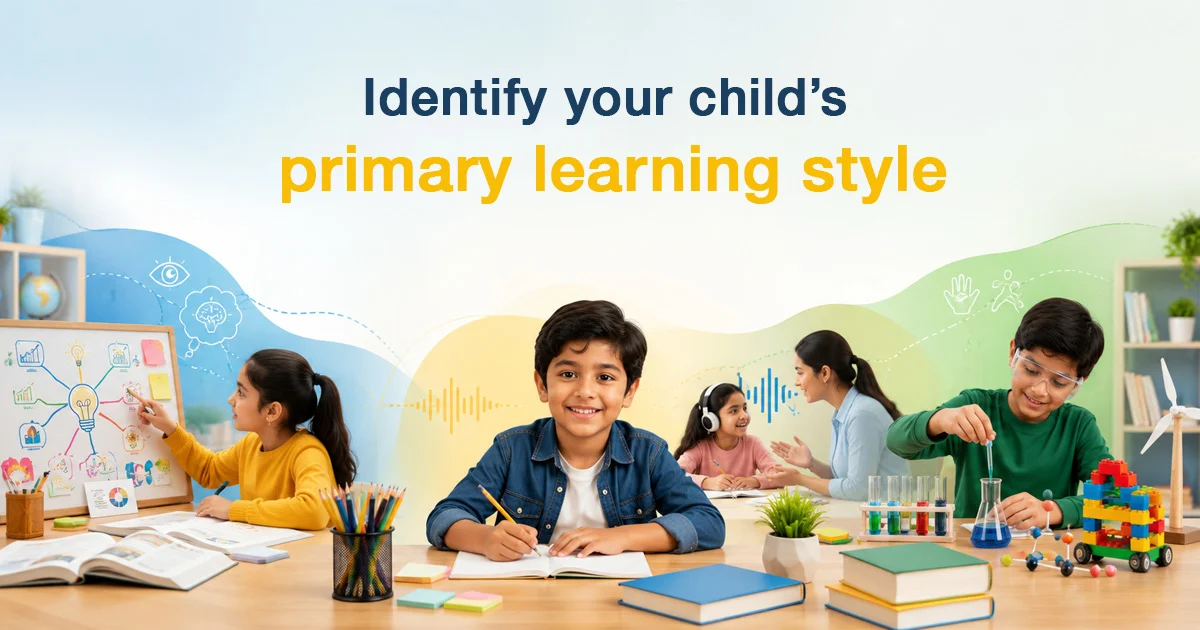
Every child learns differently, and those differences often show up in everyday academic struggles. While some children quickly grasp concepts through visuals, others learn better by listening, discussing, or doing things hands-on. Recognizing your child’s natural learning style can help reduce frustration, improve focus, and make learning feel far more engaging and rewarding for them.
The Importance of Personalized Learning
Some children learn best through images and diagrams, while others understand concepts more clearly through discussion, repetition, or practical activities. Paying attention to these patterns can help parents better support their child’s academic progress and reduce common learning challenges at home. Understanding learning styles in education also helps children retain information more effectively and build stronger problem-solving skills over time.
Careful observation often reveals how a child responds to different subjects, activities, and teaching methods. These insights can help parents and educators create a more supportive and engaging learning environment tailored to the child’s strengths.
Identifying Core Learning Tendencies
While most children learn through a mix of different methods, they often respond more strongly to certain approaches than others. Identifying these preferences can help parents and educators make learning more engaging, comfortable, and effective for the child.
| Style |
Common Tendencies |
Best Support Strategies |
| Visual |
Responds well to charts, diagrams, colours, and written instructions. |
Use flashcards, mind maps, diagrams, and highlighted notes. |
| Auditory |
Understands concepts better through listening, discussion, and verbal explanation. |
Encourage reading aloud, discussions, storytelling, and educational audio content. |
| Kinesthetic |
Learns more effectively through physical activity, experimentation, and hands-on tasks. |
Include practical activities, movement-based learning, models, and experiments. |
Understanding Different Learning Styles
Every child processes information differently, which is why identifying individual learning preferences can make classroom experiences more meaningful and effective. Schools such as JAIN Heritage School often encourage varied learning approaches to help students engage with concepts in ways that suit their strengths.
Visual Learning
Visual learning thrives on what can be seen. For these children, a picture really conveys a lot. They often benefit from seeing the "big picture" before diving into details. To support a child with this preference, try using color-coded notes or drawing out complex problems. In many modern classrooms, teachers use different learning styles to ensure these students remain engaged through charts and videos.
Auditory Processing
Auditory learners often understand and retain information more effectively when they hear it explained aloud. These children may enjoy listening to stories, participating in conversations, or repeating information verbally while studying. At home, parents can support this learning preference by encouraging reading aloud, asking children to explain concepts in their own words, or using rhymes, songs, and educational audio content to reinforce lessons.
Kinesthetic and Tactile Exploration
Children who respond well to Kinesthetic learning often understand concepts more clearly through active participation and hands-on experiences. They may benefit from activities that involve building, experimenting, drawing, or interacting directly with learning materials rather than only listening or reading for long periods. Practical exercises such as science experiments, role-playing activities, educational games, or using objects to solve mathematical problems can help make lessons more engaging and easier to retain.
Simple Ways to Support Learning at Home
Creating a supportive learning environment at home does not always require major changes. Often, a few thoughtful adjustments can help children stay more comfortable, focused, and engaged while studying. These small study ideas can also help parents better understand how their child responds to different learning methods.
- Notice Learning Habits: Pay attention to how your child naturally approaches activities. Some children prefer drawing and observing, while others enjoy discussion, building, or interactive tasks.
- Use Visual Tools: Children who respond well to visual learning may benefit from whiteboards, charts, color-coded notes, or visual schedules that make information easier to organize and recall.
- Include Movement Breaks: For children who connect strongly with kinesthetic learning, short breaks involving stretching, walking, or hands-on activities can help maintain focus during longer study sessions.
- Create Flexible Study Areas: One of the most effective small study ideas is offering different study setups, such as floor seating, desks, or quiet corners, so children can learn in a space where they feel comfortable.
The goal is not to place children into fixed categories but to recognize patterns that help them learn more effectively. Understanding different learning styles can help parents and educators create learning experiences that feel more engaging, balanced, and supportive over time.
Conclusion
Every child learns in their own way, and recognizing those differences can make learning more engaging, comfortable, and effective over time. When parents and educators pay attention to how children respond to different teaching methods, they can provide support that encourages confidence, curiosity, and long-term academic growth.
Schools such as JAIN Heritage School also emphasise creating learning environments that acknowledge individual strengths and encourage holistic development throughout a child’s educational journey.
FAQs
Q1. What are the four learning styles for children?
A1. The four primary styles are Visual (learning by seeing), Auditory (learning by hearing), Read/Write (learning through text), and Kinesthetic (learning by doing).
Q2. What are the 5 phases of experiential learning?
A2. The phases typically include Experiencing (the activity), Sharing (reporting observations), Processing (analyzing the experience), Generalizing (connecting to the real world), and Applying (using what was learned).
Q3. What are the three primary learning styles?
A3. The three most commonly recognized primary styles are Visual, Auditory, and Kinesthetic.
Q4. What are your top 3 types of learning styles?
A4. The top three types usually refer to the VAK model: Visual learners who use sight, Auditory learners who use sound, and Kinesthetic learners who use physical sensation and movement.
|

 Print
Print